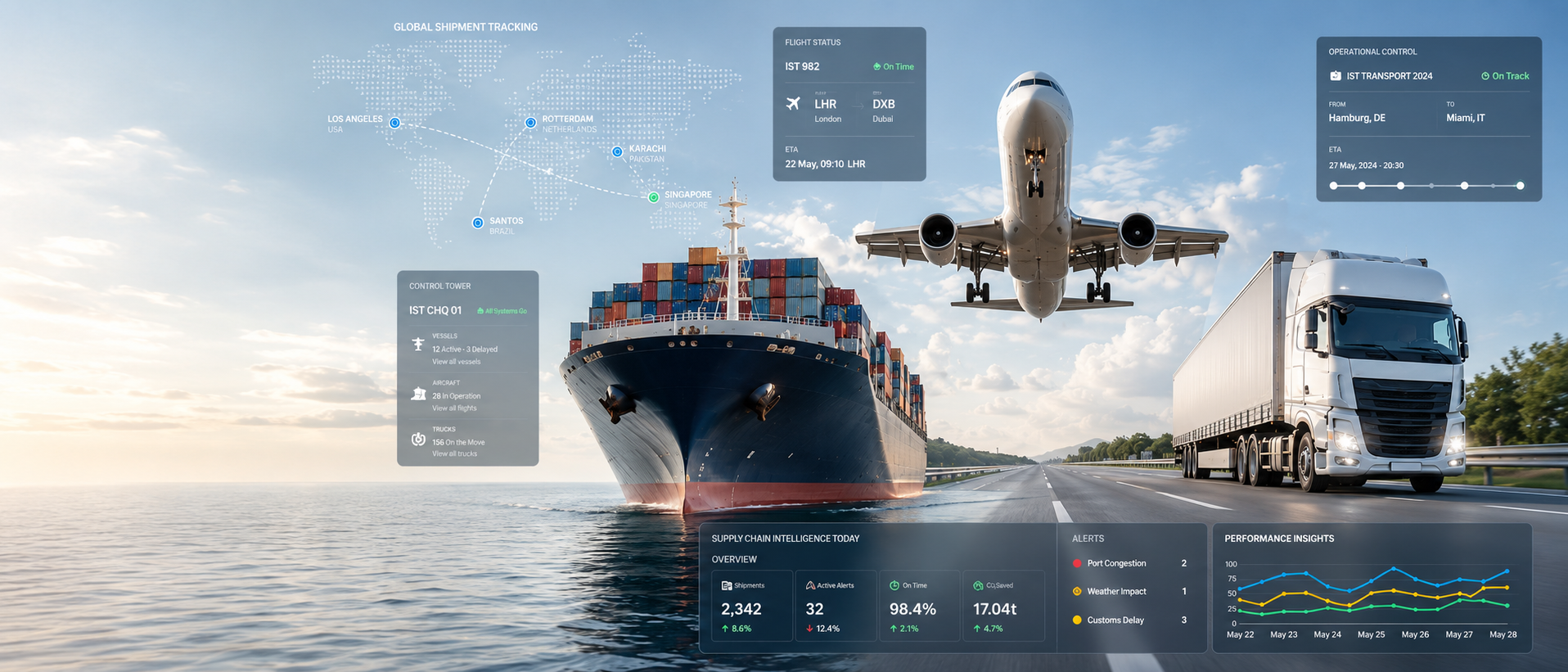
Freight Forwarding System
One forwarding operating core from quote to invoicing
Air, sea, and land execution with connected documents, cost control, invoice readiness, and margin visibility.
Quote faster. Execute cleaner. Protect margin.
The IST Freight Forwarding Management System gives forwarders one system for quotation, booking, shipment control, documentation, tracking, margin visibility, and reconciliation across air, sea, and land. Built for forwarders that need one internal system for commercial control, shipment execution, documentation, cost capture, and invoice readiness across air, sea, and land.
Commercial control
Quotes, lane pricing, customer handoff, and service commitments start inside one system.
Shipment control
Bookings, milestones, documents, and exceptions stay tied to one job record.
Financial control
Costs, invoices, and reconciliation move with the shipment instead of after it.
Expansion path
Add digital sales, customer portal, and deeper connectivity without replacing the core.
Clear system boundary
This page is the internal forwarding system. If you also want public rate search, self-service booking, and a white-label customer experience, the next layer is the Digital Freight Forwarder Suite.
3 transport modes
Air, sea, and land managed in one operating and financial system.
1 shared job file
Commercial, operational, document, and cost control tied to the same shipment record.
Quote-to-cash control
Quotation, booking, invoicing, and reconciliation stay connected instead of drifting across tools.
Expansion-ready
Add customer portal, carrier connectivity, and digital-forwarder capability when you are ready.
Platform logic
One forwarding system for the whole operating cycle
This is where the Freightos influence helps most: strong hierarchy, fewer messages, and a clear buyer story. The page starts with the operational promise, then shows the product pillars that matter to freight forwarders.
Quote faster and price with control
Give commercial teams a clean way to price lanes, structure quotes, and move approved work into operations without rekeying.
Customer quotations with charge logic and service structure
Mode-aware pricing across air, sea, and land
Cleaner handoff from sales to shipment execution
Run every shipment from one job record
Keep booking, documents, milestones, and execution in the same shipment lifecycle so operations do not rebuild context on every exception.
Bookings, milestones, and mode-specific control in one system
Document generation and indexed shipment archiving
Import, export, FCL, LCL, and consolidation support
Protect margin before it disappears
Connect costs, invoice timing, and profitability to the live shipment record so finance sees the same truth as operations.
Cost capture and reconciliation by shipment and customer
Invoice readiness tied to actual execution
Margin visibility across branches, lanes, and accounts
Mode coverage
Air. Sea. Land. One commercial and financial truth.
Forwarders should not need separate silos for each mode just to keep execution moving. IST keeps mode-specific workflow where it belongs while preserving one shared job file and one shared margin view.
Sea freight
FCL, LCL, import, export, consolidation, carrier coordination, and document control in one sea workflow.
Air freight
Air booking, AWB-driven execution, flight visibility, and customer coordination without splitting to another tool.
Land transport
Pre-carriage, on-carriage, inland handoff, and delivery coordination connected to the forwarding job file.
Multi-branch forwarding
Keep branch activity, customer service, and financial control aligned even when operational ownership is distributed.
Why forwarders change systems
Quotations, bookings, documents, tracking, and invoicing often live in separate tools, making shipment profitability hard to trust.
Multi-modal import and export operations create heavy documentation and exception handling that overwhelms manual teams.
Customer service slows down when shipment status, documents, and financial exposure must be reconstructed from multiple systems.
What better control looks like
Increase control over shipment profitability by connecting quotation, costs, execution, and invoicing.
Improve service speed with faster quotation, stronger shipment visibility, and better document readiness.
Scale multi-modal forwarding without building separate operating silos for each transport mode.
Related layers
Choose the layer you need now, then expand cleanly
This removes the duplication problem across the site. The forwarding management system is not the same thing as the digital-forwarder layer, and the page now makes that difference obvious.
Freight Forwarding Management System
The internal operating core for quotes, jobs, documents, costs, invoicing, and profitability.
You are hereDigital Freight Forwarder Suite
The customer-facing digital sales and service layer for rate search, schedules, self-service booking, and white-label portal deployment.
Explore digital layerEDI, portal, and financial add-ons
Add carrier connectivity, customer portal access, and tighter financial control once the forwarding core is stable.
Explore add-onsUseful next step
Need digital customer search, booking, and portal visibility too?
Then the next page should be the Digital Freight Forwarder Suite. That is the customer-facing digital layer for self-service sales and service on top of the forwarding core.
Forwarder FAQ
Questions buyers ask before they switch
The structure here follows what works well on Freightos: tighter answers, fewer blocks, and a clean route to the next action.
If you want a simpler educational read before the demo, start with What Is Freight Forwarding Software?.
Build the forwarding core first. Add the digital layer next.
Start with the operating system that keeps quotes, jobs, documents, costs, and invoices aligned. Then expand into portal, connectivity, and digital sales when the business is ready.