Terminals
Terminal Operations — Containers, General Cargo, and RoRo
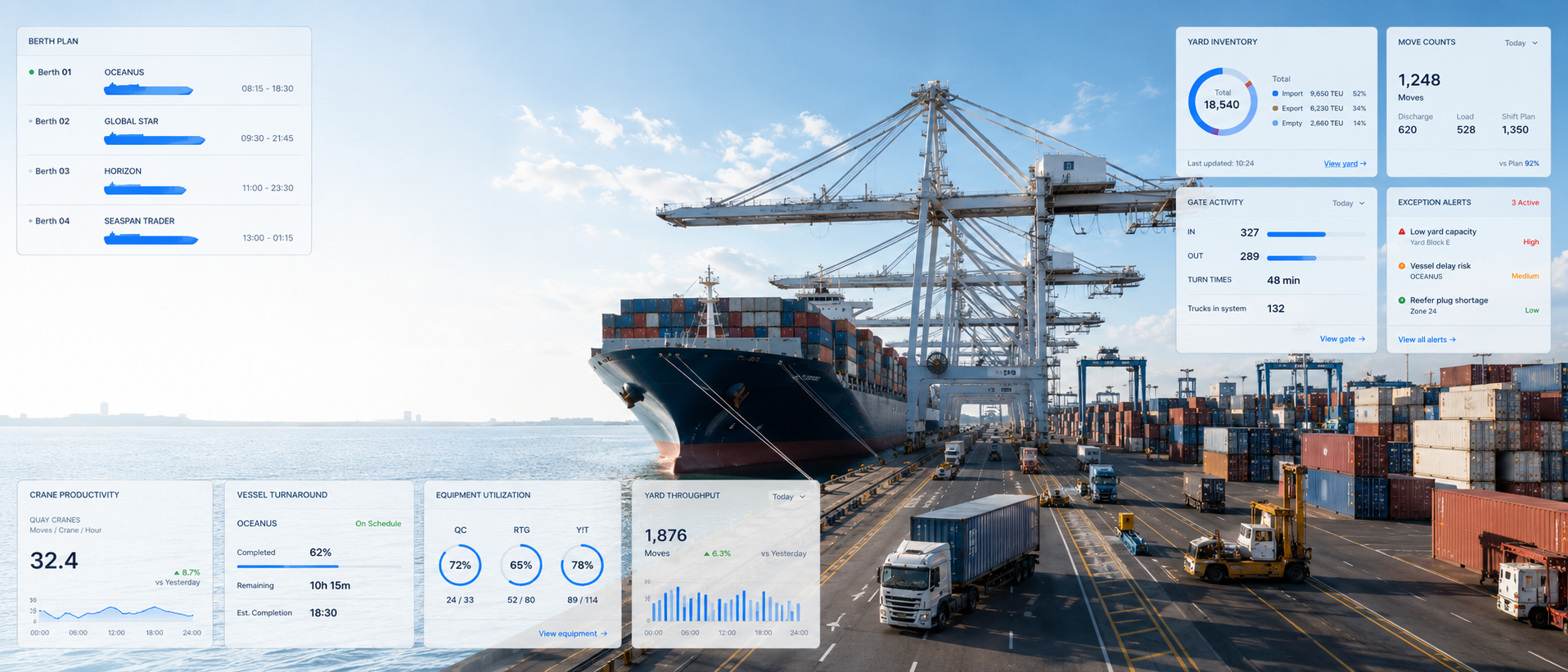
The IST Terminal Operating System (TOS) manages the complete terminal lifecycle for container terminals, general cargo terminals, and RoRo operations including gate management, yard allocation, vessel operations, cargo handling, storage, billing, and performance reporting.
Operational cycle
Gate-In / Gate-Out
Manage truck arrivals, container inspections, documentation verification, and automated gate processing.
Yard Allocation
Optimize yard space with automated slot assignment, stacking rules, and real-time yard visualization.
Vessel Operations
Plan and execute vessel loading/discharge with bay plan management and equipment coordination.
Cargo / Container Movement
Track every move — discharge, load, shift, rehandle — with equipment assignment and operator dispatch.
Storage Management
Monitor dwell time, calculate storage charges, and manage cargo release workflows.
Billing & Invoicing
Automated tariff application for handling, storage, reefer monitoring, and ancillary services.
Performance Reporting
Vessel turnaround time, crane productivity, yard utilization, gate throughput, and operational KPIs.
Terminal Operations — Containers, General Cargo, and RoRo
The IST Terminal Operating System (TOS) manages the complete terminal lifecycle for container terminals, general cargo terminals, and RoRo operations including gate management, yard allocation, vessel operations, cargo handling, storage, billing, and performance reporting.
Quick answer
The IST Terminal Operating System gives container, general cargo, and RoRo operators one system for gate control, yard planning, vessel operations, billing, and performance reporting.
Connected Smart Terminal Ecosystem
One connected system for visibility, execution, service control, and financial alignment across the terminal.
System relationship
Hover or click any box to see how it connects back into the unified terminal system.
What usually pushes buyers to change
Gate, yard, vessel, and billing teams often work from different records, so throughput gains in one area create delays in another.
Storage, handling, and ancillary revenue leak when moves are operationally visible but financially disconnected.
Terminal managers struggle to see berth, yard, and equipment performance in time to act during live operations.
When this is the right time to buy
The terminal is expanding capacity, cargo mix, or customer commitments and needs tighter control over execution.
Yard congestion, vessel turnaround, or gate speed has become a board-level issue.
Commercial pressure is rising to prove service quality while capturing all operational revenue.
Who this is best for
Container, general cargo, multi-purpose, or RoRo terminals that need operational and financial control in one system.
Operators that want shared visibility across planning, execution, commercial, and finance teams.
Facilities replacing partial digitization with a true terminal software operating model.
Operational complexity fit
Best fit when the terminal manages multiple berths, yard rules, cargo types, or revenue models.
Strong fit for operators balancing productivity targets with billing accuracy and stakeholder visibility.
Especially valuable when vessel planning, gate speed, and storage monetization must improve together.
Core capabilities
Multi-Cargo Support
Handle containers, general cargo, breakbulk, RoRo vehicles, and project cargo in one system.
Yard Planning
Visual yard management with drag-and-drop allocation, stacking optimization, and hazardous cargo segregation.
Equipment Management
Track cranes, reach stackers, terminal tractors, and all handling equipment with maintenance scheduling.
Reefer Monitoring
Temperature monitoring, power connection tracking, and automated alerts for reefer containers.
Customs Integration
Electronic customs declarations, hold/release management, and regulatory compliance.
Shipping Line Integration
EDI connectivity with shipping lines for bay plans, gate moves, and container status updates.
Typical integrations
Integration maturity to plan for
Review existing EDI and customs requirements alongside truck, reefer, and billing dependencies.
Clean equipment, yard, berth, and tariff master data so operational logic matches how the terminal really runs.
Plan how finance, ERP, or invoicing systems will receive transaction-derived charges and revenue events.
Implementation approach
Define gate flow, yard structure, berth logic, tariff rules, and cargo-type workflows before live operations move into the system.
Phase vessel, yard, and gate modules around operational readiness and message connectivity with shipping lines or customs.
Add dashboards, customer services, and financial controls once transactional accuracy is trusted on the live floor.
What happens after go-live
Terminals usually expand into BI, customer portal, and ERP-connected financial workflows once live execution stabilizes.
Operational data becomes usable for berth productivity reviews, congestion analysis, and commercial service differentiation.
Management can compare cargo segments, customers, and service performance with more confidence.
Executive outcomes
Increase throughput with better yard, berth, and equipment orchestration instead of relying on manual heroics.
Capture every move, storage day, and ancillary service with much stronger billing discipline.
Give terminal leadership real-time visibility into productivity, congestion, and customer-impacting exceptions.
Departmental outcomes
Planning
Better berth, yard, and resource decisions with one operational picture.
Operations
Cleaner coordination between gate, yard, vessel, and cargo teams during live execution.
Finance
More dependable charge capture from handling, storage, reefer, and service activity.
Why buyers hesitate
Terminal changeover is too risky
That is why rollout should be phased by workflow, cargo segment, or site readiness instead of treated as a single cutover event.
Our cargo mix is unusual
IST is designed for mixed terminal environments, including containers, general cargo, and RoRo, rather than only one cargo archetype.
Billing is managed elsewhere
Operational billing discipline still needs the TOS because revenue assurance depends on real transaction capture at source.
Commercial model considerations
The business case is usually a combination of throughput improvement, billing assurance, and service consistency.
Operators often prioritize the cargo segment or terminal area with the greatest operational pain for the first rollout wave.
The system pays back fastest where manual coordination currently constrains berth productivity or revenue capture.
Risks of not digitizing
As cargo volumes grow, manual yard and berth coordination becomes more expensive and less predictable.
Revenue leakage compounds quietly when handling and storage data are not tied to charge logic at the point of execution.
Without live operational visibility, service issues are usually discovered after customer impact has already happened.
System add-ons that matter for this solution
System add-on
EDI and Connectivity
EDI & Connectivity keeps vessel and container communication aligned with shipping lines, customs, and external partners.
Explore EDI and ConnectivitySystem add-on
Accounting & ERP
Accounting protects revenue by turning live handling and storage events into disciplined billing and reporting.
Explore Accounting & ERPSystem add-on
BI and Analytics
BI & Analytics gives terminal leadership real-time KPI visibility across berth, gate, and yard performance.
Explore BI and AnalyticsFrequently asked questions
Related resources
What Is a Terminal Operating System?
A Terminal Operating System (TOS) is software that manages port and terminal operations including gate control, yard planning, vessel operations, cargo handling, storage, equipment management, billing, and performance reporting for container, general cargo, and RoRo terminals.
How to Reduce Billing Leakage in Shipping and Logistics
Billing leakage in shipping and logistics refers to revenue lost through unbilled services, missed charges, incorrect tariff application, manual invoicing errors, and inconsistent charge capture across departments, branches, and entities.
How to Digitize Terminal, Shipping, and Logistics Operations
Digitizing port, terminal, and logistics operations means replacing manual, paper-based, and spreadsheet-driven processes with integrated software systems that automate operations, connect stakeholders, improve visibility, and enable data-driven decision making.
Related solutions
Terminals
Dry Port Management System
Purpose-built for dry ports and inland container depots that serve as extensions of seaports, handling customs clearance, storage, and cargo distribution.
Terminals
Container Yard Management System
Built for container yards, depots, and off-dock facilities that store, repair, and manage container equipment for shipping lines and leasing companies.
Terminals
Vehicle Storage Terminal System
Designed for vehicle storage terminals, automotive logistics parks, and vehicle processing centers that handle vehicle imports, storage, and distribution.