Terminals
Container Yard & Depot Operations — Storage, Repair, and Inventory Control
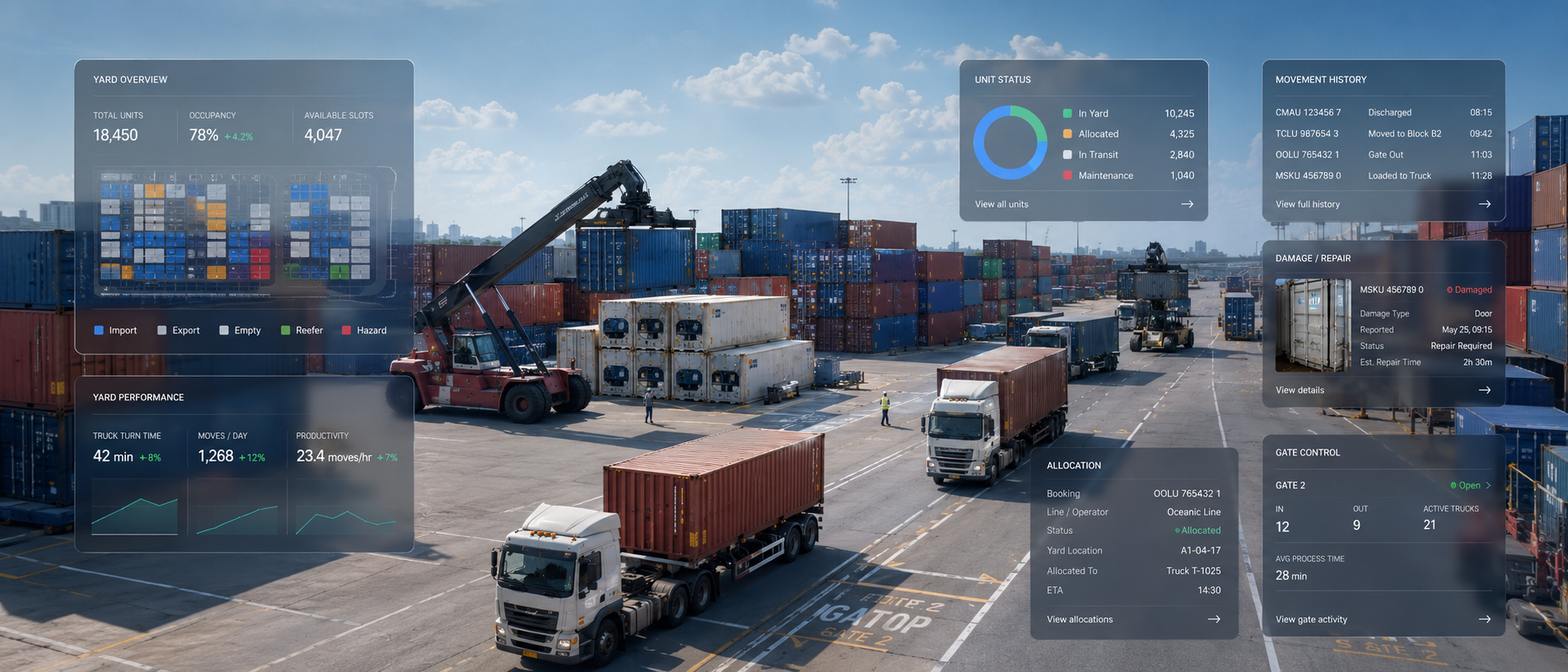
The IST Container Yard Management System manages container storage yards and depot operations including container storage, repair and maintenance tracking, gate operations, inventory control, movement tracking, and billing for container yard and depot facilities.
Operational cycle
Container Storage
Receive and store containers with condition surveys, position tracking, and owner identification.
Repair & Maintenance
Assess damage, create repair estimates, execute repairs, and track maintenance history.
Gate Operations
Process gate-in and gate-out transactions with driver verification and container inspection.
Inventory Control
Maintain real-time inventory by container type, size, condition, and owner across yard locations.
Movement Tracking
Track all container movements within the yard and between yards, ports, and customer locations.
Billing
Calculate storage, handling, repair, and lift charges with automated invoicing per container owner.
Container Yard & Depot Operations — Storage, Repair, and Inventory Control
The IST Container Yard Management System manages container storage yards and depot operations including container storage, repair and maintenance tracking, gate operations, inventory control, movement tracking, and billing for container yard and depot facilities.
Quick answer
The IST Container Yard Management System gives container depots and yards operational control over gate activity, storage, condition surveys, repairs, owner billing, and inventory visibility.
What usually pushes buyers to change
Condition-survey, repair, storage, and gate workflows are often managed separately, so container history becomes unreliable.
Owner-specific billing and repair approval cycles create leakage when physical work is not tied to the financial record.
Inventory accuracy drops as depots grow, especially when damaged, empty, and repaired units are moving constantly.
When this is the right time to buy
Container owners want stronger repair visibility, faster approvals, or cleaner depot reporting.
The yard is scaling and inventory confidence is no longer high enough for commercial or operational decisions.
Manual repair estimation or owner billing is causing margin leakage and dispute risk.
Who this is best for
Container yards, depots, and maintenance facilities handling storage, M and R, and gate workflows.
Operators serving multiple shipping lines, leasing companies, or container owners with segregated billing needs.
Businesses that need depot software with both operational traceability and owner-facing discipline.
Operational complexity fit
Best fit where storage, inspection, repair, and release all need to be governed together.
Strong fit for depots handling multiple owners, mixed condition states, and high gate activity.
Especially valuable when repair approval and revenue assurance are commercially sensitive.
Core capabilities
Condition Survey
Digital damage recording with photo documentation and standardized IICL damage codes.
Repair Estimation
Generate repair estimates with labor, material, and time calculations for owner approval.
Multi-Owner Management
Segregate operations and billing by container owner — shipping lines, leasing companies, or private owners.
Yard Visualization
Visual yard map with container positions, stacking, and search functionality.
Typical integrations
Integration maturity to plan for
Confirm owner identifiers, tariff rules, gate document flow, and repair approval practices.
Clean up condition codes, inventory references, and repair pricing data before rollout.
Decide whether ERP, invoice, or customer communication systems need integration early in the deployment.
Implementation approach
Set up yard structure, gate rules, owner profiles, damage workflows, and repair-estimation logic first.
Move condition surveys, repair authorization, and work completion into the live container record before extending reporting.
Layer financial controls and owner-facing visibility once inventory and repair traceability are stable.
What happens after go-live
Owners receive cleaner status, repair, and inventory reporting because the depot record is consistent.
Management can analyze damage patterns, turnaround, and repair profitability more confidently.
Depot teams spend less time reconciling yard counts with survey and billing records.
Executive outcomes
Improve inventory accuracy across empty, damaged, repaired, and released equipment.
Capture repair and storage revenue more reliably by tying yard activity to owner billing logic.
Give management clearer visibility into turnaround, repair backlog, and owner service performance.
Departmental outcomes
Gate operations
Faster check-in, release, and container status validation.
M and R
Better control over survey, estimate, approval, and repair execution.
Finance
Stronger owner billing, repair revenue control, and audit traceability.
Why buyers hesitate
Our surveyors already use paper or spreadsheets
That is common, but it leaves too much room for missed work, unclear approval history, and owner disputes.
Owner billing rules differ too much
The system is designed for multi-owner segregation, which is exactly why depot operations need structured data.
The yard team only needs better visibility
Visibility without repair and billing alignment still leaves margin risk and weak auditability.
Commercial model considerations
Commercial value is strongest when inventory accuracy and repair monetization both matter.
Multi-owner environments benefit from system discipline because segregation and service transparency influence renewals.
Rollout often starts with gate plus survey workflows, then expands into repair and billing depth.
Risks of not digitizing
Inventory inaccuracy becomes costlier as volume grows and owner expectations get stricter.
Repair revenue loss is hard to recover once work is performed without a full digital trail.
Manual survey and approval practices increase dispute risk with every additional owner and depot lane.
System add-ons that matter for this solution
System add-on
Customer Portal
Customer Portal gives shipping lines and leasing companies direct visibility into inventory, repair status, and documents.
Explore Customer PortalSystem add-on
Accounting & ERP
Accounting protects storage, handling, and repair revenue in multi-owner depot operations.
Explore Accounting & ERPSystem add-on
BI and Analytics
BI & Analytics helps depot leadership track repair backlog, turnaround, and owner profitability.
Explore BI and AnalyticsFrequently asked questions
Related resources
Related buying and implementation resources will appear here as this solution library expands.
Related solutions
Terminals
Terminal Operating System
A unified terminal management system that supports multiple cargo types — containers, breakbulk, general cargo, and RoRo vehicles — within a single operational environment.
Terminals
Dry Port Management System
Purpose-built for dry ports and inland container depots that serve as extensions of seaports, handling customs clearance, storage, and cargo distribution.
Terminals
Vehicle Storage Terminal System
Designed for vehicle storage terminals, automotive logistics parks, and vehicle processing centers that handle vehicle imports, storage, and distribution.