Envío
Gestión de agencias navieras: EDI, liberación, control de contenedores y liquidación de principales
The IST Shipping Agency Management System manages the full agency cycle for shipping line representatives including EDI exchange, import manifest and arrival notification, shipping orders and export bills of lading, billing and invoicing, delivery order issuance, container control, loading and discharge lists, and disbursement accounts for the principal.
Operational cycle
EDI & Manifest Exchange
Exchange import and export manifests with shipping lines, other shipping agents, customs authorities, and gate in or gate out movement sources.
Import Manifest & Arrival Notification
Receive manifests through EDI, Excel, or manual entry, manage expected and actual arrival dates, and issue consignee arrival notices by email or fax with Arabic customs support.
Shipping Orders & Export B/L
Enter draft shipping orders, issue container release orders after shipper confirmation, and generate original export bills of lading once cargo is loaded on board.
Billing, Invoicing & Deposits
Automatically issue invoices based on agreed tariffs, receive shipper or consignee deposits, deduct demurrage, damage, and delivery order expenses, and refund remaining balances.
Delivery Order & Release Control
Issue delivery orders with system-backed verification of payments, documents, and release conditions before cargo handover.
Container Control & Terminal Lists
Control the full container cycle from discharge to consignee delivery, empty return, export reuse, transit handling, preloading, and final loading or discharge list preparation.
Disbursement Accounts
Summarize freight and demurrage collected for the principal, calculate agency commission, record remittances, issue debit and credit notes, and prepare monthly statements of account.
Shipping Agency Management — EDI, Release, Container Control, and Principal Settlement
The IST Shipping Agency Management System manages the full agency cycle for shipping line representatives including EDI exchange, import manifest and arrival notification, shipping orders and export bills of lading, billing and invoicing, delivery order issuance, container control, loading and discharge lists, and disbursement accounts for the principal.
Quick answer
The IST Shipping Agency Management System gives shipping agents one operating environment for EDI, manifest intake, arrival notices, shipping orders, export bills of lading, local charge capture, delivery orders, container control, and principal settlement.
What usually pushes buyers to change
Manifest handling, arrival notices, shipping orders, and delivery order issuance are often split between teams, causing release delays and documentation risk.
Deposits, demurrage, damage, and delivery order expenses are frequently tracked manually, which creates billing leakage and refund disputes.
Agencies representing multiple principals or branches struggle to keep tariffs, container stock, remittances, and statements audit-ready.
When this is the right time to buy
Cargo release is too slow, consignees complain, or the agency is adding staff just to keep manifests, invoices, and delivery orders moving.
Principals expect cleaner statements of account, tighter remittance control, and more disciplined agency governance.
The agency is onboarding additional shipping lines or branches and needs central control without multiplying systems.
Who this is best for
Shipping agencies representing one or more principals in import and export container operations.
Agency groups that need consistent manifest, release, container, and financial control across branches.
Operations replacing manual manifest, delivery order, and settlement workflows with shipping agency software.
Operational complexity fit
Best fit when the agency handles high import and export volumes, multiple principals, and substantial detention or local-charge complexity.
Strong fit where customer service, documentation, operations, and finance depend on real-time cargo, payment, and release status.
Particularly useful once delivery order speed, container control, and principal settlement accuracy become competitive differentiators.
Core capabilities
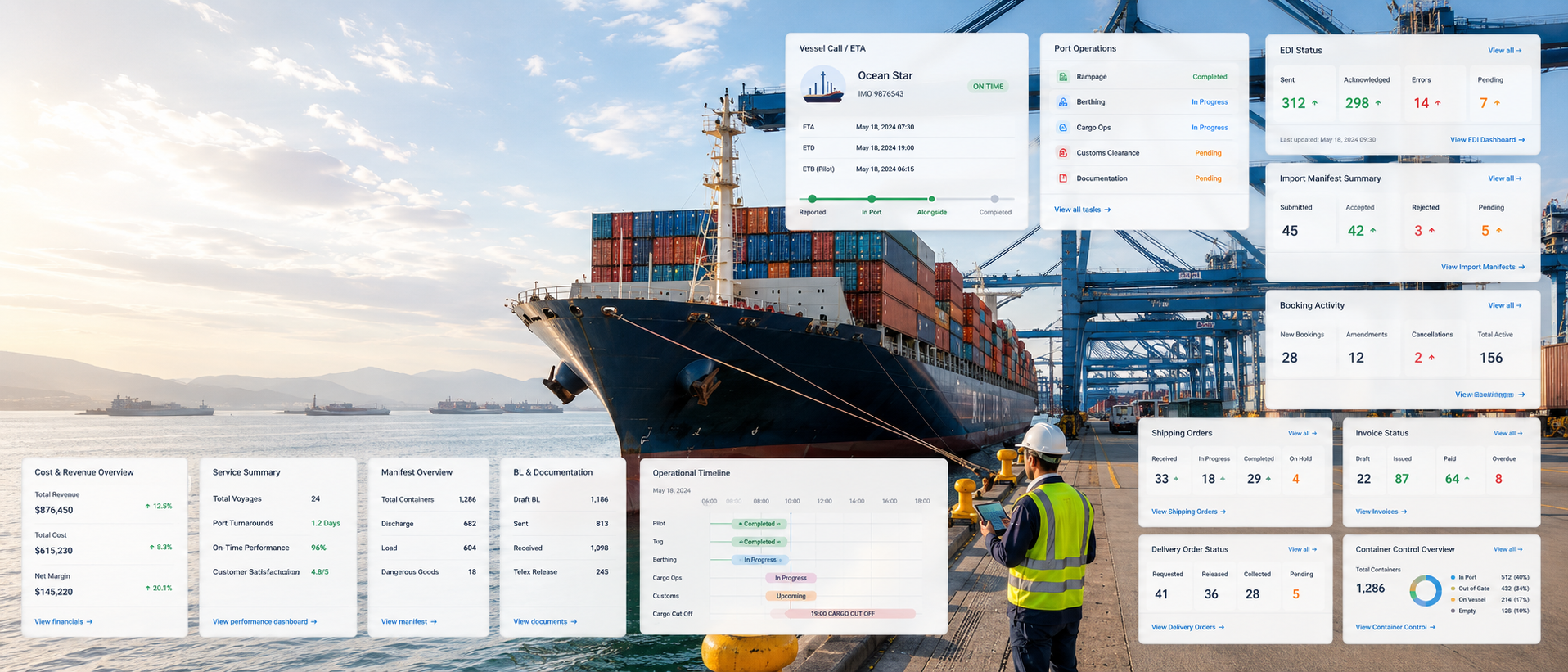
Interactive Dashboard
Real-time dashboard summarizing operational activity, container status, release flow, and financial performance.
EDI Connectivity
Exchange manifests with principals, agents, and customs while receiving gate in and gate out movements electronically.
Import & Export Documentation
Manage import manifests, arrival notices, shipping orders, export bills of lading, and delivery order workflows in one agency process.
Automated Billing & Deposit Control
Apply agreed tariffs automatically, receive customer deposits, deduct charges, and return remaining balances with full auditability.
Container Cycle Control
Track containers across discharge, consignee delivery, empty return, export release, transit handling, and overdue follow-up across terminal and customer locations.
Disbursement Accounts
Handle freight and demurrage collection, commission calculation, remittances, debit or credit notes, and monthly statements for principals.
Branch & Accounting Integration
Link branches to one central database and integrate operational and financial events with accounting environments.
Security & Flexible Configuration
Support country-specific operating rules, configurable master data, and multi-level user privileges by individual or group.
Typical integrations
Integration maturity to plan for
Confirm EDI counterparties, customs submission needs, terminal release verification logic, and where gate events enter the workflow.
Clean up principal tariff tables, customer and consignee master data, deposit handling rules, and detention or demurrage exceptions.
Identify how accounting systems, collections, banking, and remittance reporting need to connect with release and settlement decisions.
Implementation approach
Map principal-specific tariffs, deposit logic, free-time rules, release conditions, and import or export document flow first.
Stabilize EDI, manifest intake, arrival notice generation, shipping order, and delivery order workflows before expanding self-service and reporting.
Phase disbursement accounts, principal reporting, and accounting integration once operational releases are reliable.
What happens after go-live
Agencies usually expand into customer portal, payments, and BI once manifest, release, and billing cycles are under control.
Principal reporting becomes more timely because shipment, release, remittance, and financial data are already aligned in the workflow.
Teams spend less time cross-checking manifests, charges, container stock, and release conditions across email threads.
Executive outcomes
Accelerate cargo release without compromising controls around payment, documentation, customs, or principal requirements.
Protect local revenue by automating tariffs, deposit deductions, demurrage, damage, and documentation-related charges.
Improve principal confidence through cleaner disbursement accounts, remittance control, and repeatable agency governance.
Departmental outcomes
Customer service
Faster consignee response with clearer arrival notice, charge, and release readiness visibility.
Operations
Real-time cargo, container, terminal, and transit visibility tied to manifest and gate status.
Finance
More disciplined local-charge capture, deposit settlement, commission control, and principal segregation.
Why buyers hesitate
Our release workflow is too customized
That is common in agency environments. IST can model principal-specific release controls, document logic, and tariff variation while keeping one enterprise framework.
Detention and demurrage rules are too messy
Those rules are exactly where the system adds value by standardizing logic, exceptions, deposit deductions, and invoice readiness.
Our country rules and branch practices are different
That is precisely why configuration, branch linkage, Arabic support, and privilege control matter. The system adapts to local operating rules without fragmenting the database.
Commercial model considerations
The strongest ROI usually comes from combining cargo-release acceleration with zero-leakage local billing and cleaner principal settlement.
Multi-principal and multi-branch design matters commercially because agencies often win more business after proving governance and visibility.
A phased rollout by principal, branch, or workflow often reduces adoption risk while protecting existing cargo-release cycles.
Risks of not digitizing
Cargo-release friction damages customer experience and principal confidence faster than it appears in standard KPIs.
As volumes rise, local-charge leakage compounds because deposits, exceptions, and damage claims are handled manually and inconsistently.
Multi-principal and branch complexity becomes harder to unwind once each line evolves a separate unofficial process.
System add-ons that matter for this solution
System add-on
Customer Portal
Customer Portal helps consignees see charges, cargo status, and release readiness before calling the agency.
Explore Customer PortalSystem add-on
Online Payments and Fintech
Online Payments shortens delivery-order turnaround by linking collections and release conditions.
Explore Online Payments and FintechSystem add-on
Accounting & ERP
Accounting is critical when the agency needs airtight principal segregation and local revenue assurance.
Explore Accounting & ERPFrequently asked questions
Related resources
Related solutions
Shipping
Shipping Line System
Built for shipping lines that need full operational control over their liner services, from booking acceptance to cargo delivery and financial settlement.
Shipping
Ship Agency System (Tramp Shipping)
Built for ship agents handling tramp and bulk vessel operations where every port call is a unique event requiring precise cost estimation, execution, and financial settlement with vessel owners.