Logística
Operaciones de flota: asignación de trabajo para análisis de rendimiento
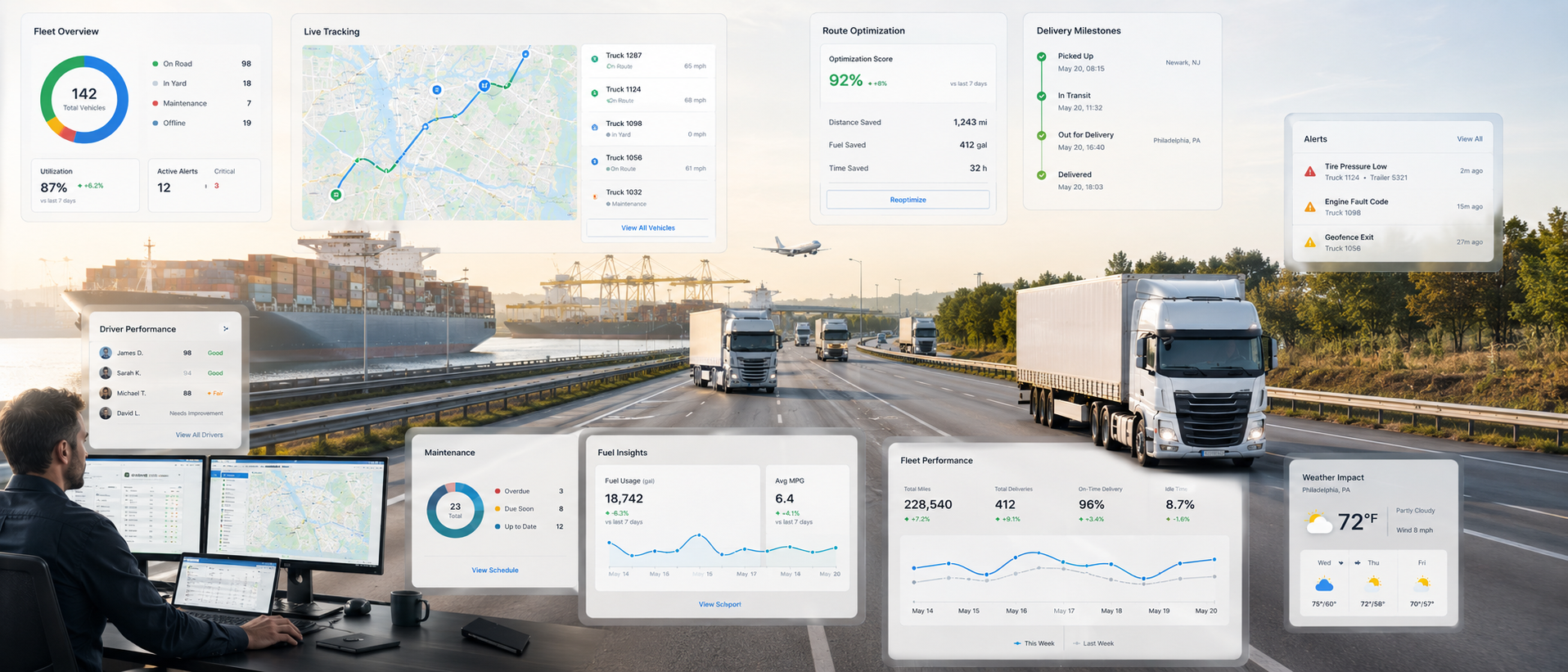
The IST Trucking & Fleet Management System manages trucking and fleet operations including job assignment, trip planning, driver allocation, fleet tracking, proof of delivery, cost capture, vehicle maintenance, and performance analytics.
Operational cycle
Job Assignment
Receive transport requests, assign to vehicles and drivers based on availability and suitability.
Trip Planning
Plan routes, stops, loading sequences, and delivery schedules for optimal efficiency.
Driver Allocation
Assign drivers based on license type, availability, location, and performance history.
Fleet Tracking
Real-time vehicle tracking with GPS integration, route monitoring, and exception alerts.
Proof of Delivery
Digital POD capture with signature, photo, and timestamp at each delivery point.
Cost Capture
Record fuel, tolls, maintenance, driver costs, and third-party expenses per trip and vehicle.
Performance Analytics
Vehicle utilization, driver productivity, on-time delivery rates, cost per km, and fleet KPIs.
Fleet Operations — Job Assignment to Performance Analytics
The IST Trucking & Fleet Management System manages trucking and fleet operations including job assignment, trip planning, driver allocation, fleet tracking, proof of delivery, cost capture, vehicle maintenance, and performance analytics.
Quick answer
The IST Trucking & Fleet Management System helps fleet operators manage dispatch, trip planning, driver allocation, telematics, proof of delivery, cost capture, maintenance, and performance analytics as one control loop.
What usually pushes buyers to change
Dispatch, GPS visibility, driver control, and trip costing often live in separate systems, so managers cannot see margin and service performance together.
Vehicle utilization drops when route planning and live fleet visibility are not tied to a disciplined dispatch workflow.
Proof of delivery, fuel, toll, and trip costs are hard to reconcile cleanly without one trip-level record.
When this is the right time to buy
The fleet is growing and dispatch teams need better control over vehicles, drivers, and exceptions.
Customer service or commercial teams want stronger ETA visibility and POD evidence.
Management needs cleaner cost-per-trip, vehicle-utilization, and maintenance insight to protect margins.
Who this is best for
Transport operators running owned, leased, or mixed fleets across local or regional networks.
Businesses that need to connect dispatch discipline with live tracking and cost visibility.
Fleets replacing manual dispatch or fragmented TMS/telematics workflows with a unified transport control layer.
Operational complexity fit
Best fit when fleet size, route density, or customer commitments make manual dispatch unreliable.
Strong fit for operators who need to balance service quality, cost control, and driver accountability.
Especially useful once management wants one view of dispatch, tracking, POD, and vehicle economics.
Core capabilities
GPS Fleet Tracking
Real-time vehicle location, route replay, geofencing, and idle time monitoring.
Vehicle Maintenance
Preventive maintenance scheduling, repair tracking, and vehicle lifecycle management.
Driver Management
License tracking, training records, performance scoring, and compliance management.
Fuel Management
Fuel consumption tracking, refueling records, and fuel efficiency analytics.
Typical integrations
Integration maturity to plan for
Identify telematics providers, trip event sources, and how current POD evidence is captured.
Clean vehicle, driver, route, and customer master data before launch.
Plan how fuel systems, ERP, or customer order systems will connect if needed in phase one.
Implementation approach
Define trip workflow, vehicle and driver logic, telematics touchpoints, and POD requirements first.
Bring dispatch, live vehicle status, and trip-cost capture into one operational record before deeper reporting rollout.
Expand into maintenance, analytics, and customer-facing visibility once dispatch accuracy is stable.
What happens after go-live
Fleet managers usually expand into BI, customer portal visibility, and tighter financial integration after dispatch is stable.
Trip history becomes useful for pricing, route design, driver coaching, and maintenance planning.
Service teams spend less time chasing proof and vehicle status updates manually.
Executive outcomes
Increase fleet utilization while reducing empty movement and dispatch friction.
Improve service transparency through better ETA control, POD proof, and live trip status.
Strengthen trip profitability by connecting operational execution to real cost capture.
Departmental outcomes
Dispatch
Clearer control of trip assignment, route exceptions, and vehicle availability.
Operations management
Better visibility into route adherence, driver performance, and utilization.
Finance
Cleaner per-trip cost visibility across fuel, tolls, maintenance, and third-party charges.
Why buyers hesitate
We already have GPS tracking
Tracking alone is not enough. The real value comes when dispatch, proof, cost, and accountability sit in the same trip workflow.
Driver adoption may be difficult
That is why the rollout should focus on the minimum high-value driver actions first, such as POD and status confirmation.
Maintenance is a separate process
Maintenance still affects availability and cost, so it belongs in the same operational control model as dispatch.
Commercial model considerations
The business case typically combines utilization improvement, service reliability, and per-trip cost control.
Operators often start with one region or customer segment, then scale once telematics and dispatch workflows are stable.
POD and ETA reliability can become a commercial differentiator with higher-value accounts.
Risks of not digitizing
Utilization and service reliability drift when dispatch decisions are not grounded in live operational data.
Trip-level cost leakage grows when fuel, toll, and third-party charges remain outside the operational trip record.
Customer confidence falls when ETAs and POD evidence are inconsistent across jobs.
System add-ons that matter for this solution
System add-on
BI and Analytics
BI & Analytics gives transport leadership visibility into utilization, cost per trip, and service performance.
Explore BI and AnalyticsSystem add-on
Customer Portal
Customer Portal can expose trip status, POD, and service transparency to key accounts.
Explore Customer PortalSystem add-on
Accounting & ERP
Accounting matters because trip profitability depends on capturing operational costs as they happen.
Explore Accounting & ERPFrequently asked questions
Related resources
Related buying and implementation resources will appear here as this solution library expands.
Related solutions
Logistics
Freight Forwarding Management System
Built for freight forwarders managing multi-modal shipments across air, sea, and land with complete visibility from quotation to final delivery and financial settlement.
Logistics
3PL Warehouse Management System
Built for 3PL providers managing multiple clients' inventory in shared or dedicated warehouse environments with complete operational, commercial, and financial control.
Logistics
Delivery Management System
Built for courier companies, parcel delivery operators, and last-mile delivery providers managing high-volume shipments across first, middle, and last mile networks.