Logística
Almacenamiento logístico de terceros: desde la entrada hasta el cumplimiento
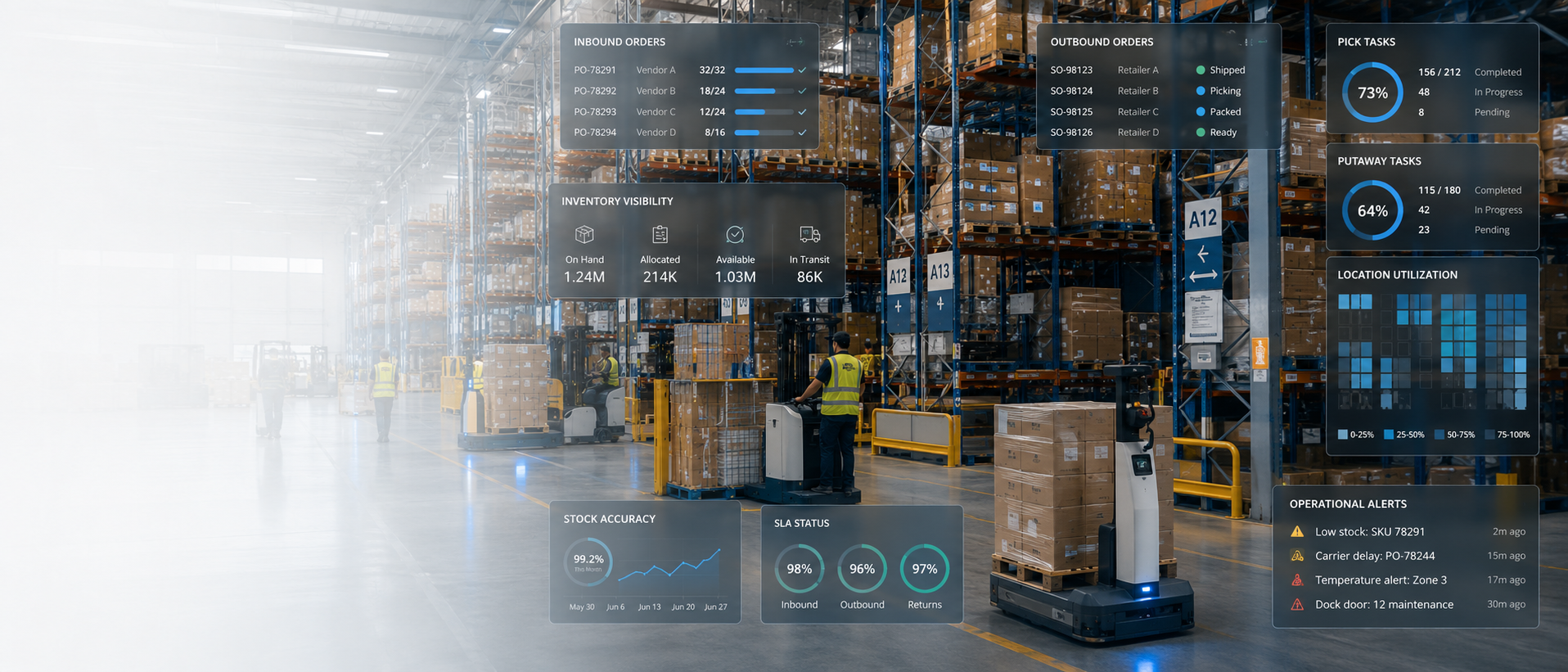
The IST 3PL Warehouse Management System manages third-party logistics warehouse operations including inbound receiving, putaway, storage, inventory control, picking, packing, fulfillment, dispatch, multi-client management, rates and contracts, automatic invoicing, and comprehensive reporting.
Operational cycle
Inbound Receiving
Receive goods from suppliers or clients with quantity verification, quality checks, and documentation.
Putaway
Assign storage locations based on product attributes, turnover rates, and warehouse zones.
Storage
Manage inventory across zones, racks, bins, and pallets with environmental controls where required.
Inventory Control
Real-time stock levels, cycle counting, adjustments, expiry tracking, and serial/batch management.
Picking
Order-based and wave-based picking with optimized routes, barcode scanning, and pick verification.
Packing
Pack verification, labeling, weight/dimension capture, and shipping documentation.
Fulfillment
Order fulfillment with integration to e-commerce platforms, marketplaces, and order management systems.
Dispatch
Outbound loading, carrier handoff, proof of dispatch, and delivery tracking initiation.
Reporting
Inventory reports, throughput metrics, client billing summaries, and SLA performance dashboards.
Third-Party Logistics Warehousing — Inbound to Fulfillment
The IST 3PL Warehouse Management System manages third-party logistics warehouse operations including inbound receiving, putaway, storage, inventory control, picking, packing, fulfillment, dispatch, multi-client management, rates and contracts, automatic invoicing, and comprehensive reporting.
Quick answer
The IST 3PL Warehouse Management System helps multi-client warehouse operators control inbound, storage, inventory, picking, value-added services, fulfillment, dispatch, client rates and contracts, and automatic invoicing in one environment.
What usually pushes buyers to change
Inventory accuracy, picking flow, and client billing often run on different tools, making SLA control and margin protection harder.
Value-added services such as kitting or labeling are performed operationally but not always billed consistently, especially when rates and contracts are handled manually.
Multi-client warehouses struggle when client-specific rules, reporting, and visibility must scale without operational fragmentation.
When this is the right time to buy
The 3PL is onboarding more clients, SKUs, or fulfillment complexity and needs better control over shared operations.
Inventory confidence, picking speed, contract discipline, or billing completeness is becoming a client-retention issue.
Management wants stronger visibility into productivity, utilization, and profitability by client or service line.
Who this is best for
3PL warehouses serving multiple clients with shared or dedicated capacity.
Fulfillment operations that need client segregation without running separate systems by customer.
Operators seeking stronger billing discipline across storage, handling, and value-added services.
Operational complexity fit
Best fit where client-specific processes, inventory complexity, or service diversity make spreadsheets unreliable.
Strong fit for warehouses balancing throughput, accuracy, and invoice completeness across multiple accounts.
Especially useful once value-added services and SLAs become a meaningful revenue and retention driver.
Core capabilities
Multi-Client Management
Segregate inventory, operations, and billing by client with independent reporting and access controls.
Barcode & RF Scanning
Mobile scanning for receiving, putaway, picking, and dispatch with real-time system updates.
Zone Management
Define warehouse zones — ambient, cold, bonded, hazardous — with product allocation rules.
Value-Added Services
Track kitting, labeling, repackaging, and other VAS activities with billing integration.
Rates & Contracts
Maintain client-specific storage, handling, fulfillment, and value-added service contracts with validity periods, charging rules, and commercial controls.
Automatic Invoicing
Convert warehouse activity, storage periods, and service events into invoice-ready charges automatically by client, contract, and billing cycle.
Typical integrations
Integration maturity to plan for
Confirm order sources, client master data, SKU references, and barcode readiness before rollout.
Map value-added service charging logic, contract rate rules, and any client-specific SLA rules early.
Plan whether ERP, carrier, marketplace, or order systems need first-phase integration.
Implementation approach
Set up warehouse layout, client structure, inventory rules, rates and contracts, and inbound-to-dispatch workflows first.
Move scanning, task execution, and automatic billing triggers into the live flow before extending analytics or customer visibility.
Roll out client reporting, portal features, and financial integration after core inventory accuracy is stable.
What happens after go-live
Operators usually expand into client portal, BI, and broader order or ERP integrations after core stock and task flow stabilizes.
Management can compare productivity, service performance, and profitability by warehouse, client, or service type.
Client onboarding becomes more repeatable because operational templates and commercial logic are already structured.
Executive outcomes
Improve inventory accuracy and fulfillment speed without sacrificing client segregation or control.
Capture more revenue by tying warehousing activity and value-added services directly to client contracts and automatic invoicing.
Scale onboarding of new clients and products without redesigning the warehouse operating model each time.
Departmental outcomes
Warehouse operations
Better control of receiving, putaway, stock moves, picking, and dispatch tasks.
Client service
Cleaner visibility into stock, orders, and SLA status by client.
Finance
More accurate contract-based billing and automatic invoicing across storage, handling, fulfillment, and value-added services.
Why buyers hesitate
Each client has different rules
That is exactly why multi-client configuration matters. IST supports client variation without turning operations into separate systems.
Our current process is partly manual but still works
It may work now, but manual accuracy, contract control, and billing discipline usually break first when new clients or SKU volume arrive.
Warehouse and billing can stay separate
Separating them is usually where value-added services and activity-based revenue start leaking.
Commercial model considerations
The strongest returns usually come from inventory control plus contract discipline and invoice automation, not just warehouse visibility alone.
Multi-client operators often deploy by facility or client cluster, then expand to the rest of the network.
A strong WMS also becomes a sales asset because the 3PL can offer better service transparency and reporting.
Risks of not digitizing
Inventory inaccuracy becomes more expensive as client count, SKU variety, and service complexity increase.
Unbilled value-added services and delayed invoice cycles quietly reduce warehouse margin long before teams realize the pattern.
Client trust erodes when stock visibility and SLA reporting depend on manual reconciliation.
System add-ons that matter for this solution
System add-on
Customer Portal
Customer Portal gives warehouse clients direct access to stock, order, and document visibility.
Explore Customer PortalSystem add-on
Accounting & ERP
Accounting is important because activity-based warehouse billing is a major 3PL profit driver.
Explore Accounting & ERPSystem add-on
BI and Analytics
BI & Analytics helps leadership track productivity, SLA performance, and client profitability.
Explore BI and AnalyticsFrequently asked questions
Related resources
Related buying and implementation resources will appear here as this solution library expands.
Related solutions
Logistics
Freight Forwarding Management System
Built for freight forwarders managing multi-modal shipments across air, sea, and land with complete visibility from quotation to final delivery and financial settlement.
Logistics
Trucking & Fleet Management System
Built for trucking companies, fleet operators, and transport divisions that need complete control over vehicle operations, driver management, and delivery performance.
Logistics
Delivery Management System
Built for courier companies, parcel delivery operators, and last-mile delivery providers managing high-volume shipments across first, middle, and last mile networks.