Envío
Operaciones de línea de extremo a extremo: desde la reserva hasta la facturación
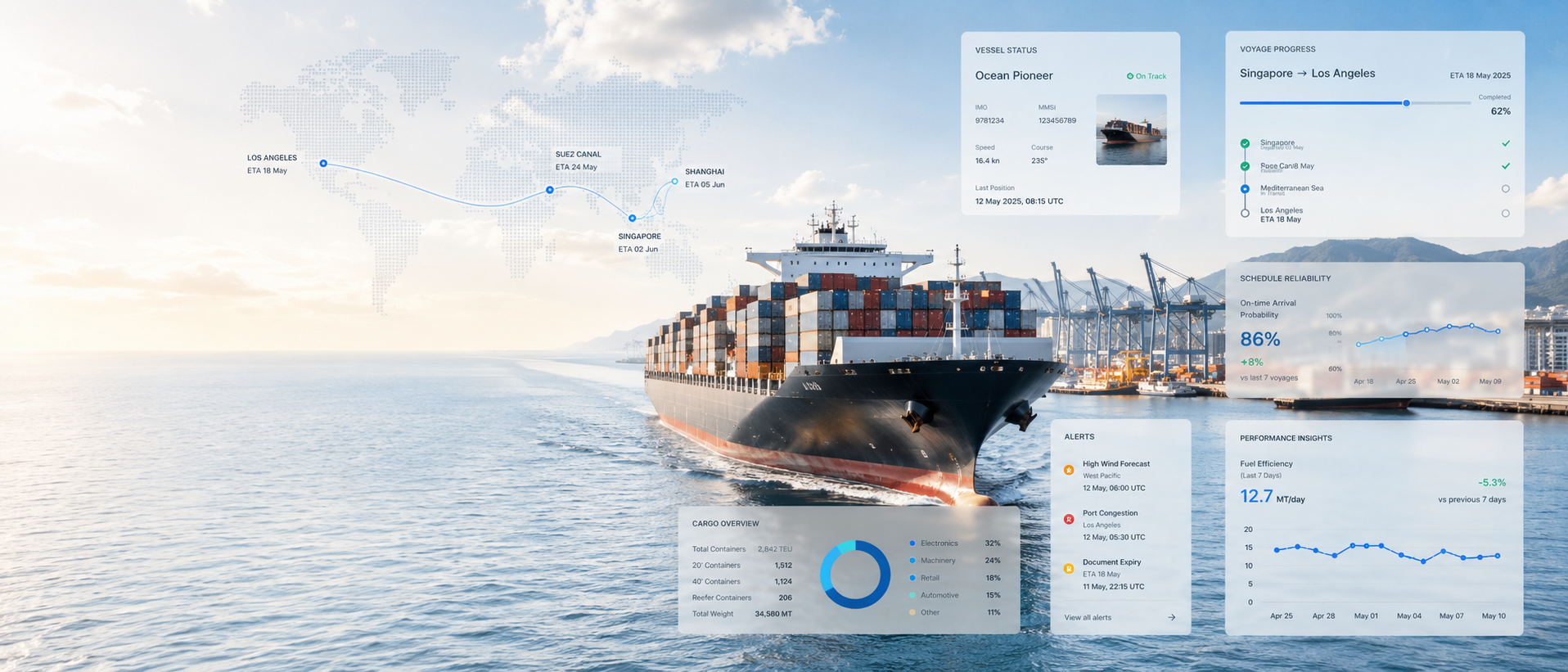
The IST Shipping Line System is a comprehensive system for managing liner shipping operations including vessel scheduling, booking management, container tracking, EDI exchange, tariff management, and automated billing across routes and trade lanes.
Operational cycle
Booking Management
Accept, confirm, and manage bookings across trade lanes with space allocation and equipment control.
Vessel Scheduling
Plan and manage vessel rotations, port calls, berthing schedules, and voyage management.
Container Movement
Track containers from empty pickup through stuffing, loading, transhipment, discharge, and delivery.
EDI Exchange
Automated exchange of BAPLIE, CODECO, COARRI, COPARN, and IFTMIN messages with terminals and agents.
Documentation
Generate bills of lading, manifests, arrival notices, and delivery orders with regulatory compliance.
Tracking & Visibility
Real-time cargo and container tracking across the entire supply chain with milestone updates.
Billing & Revenue
Automated tariff application, charge calculation, invoicing, and revenue recognition across voyages.
End-to-End Liner Operations — From Booking to Billing
The IST Shipping Line System is a comprehensive system for managing liner shipping operations including vessel scheduling, booking management, container tracking, EDI exchange, tariff management, and automated billing across routes and trade lanes.
Quick answer
The IST Shipping Line System is built for liner operators that need bookings, vessel schedules, equipment control, EDI, documentation, and billing to run as one operating model instead of disconnected teams and spreadsheets.
What usually pushes buyers to change
Bookings, equipment availability, and vessel scheduling sit in separate tools, so operations lose control when services scale across trade lanes.
EDI exceptions and documentation handoffs create avoidable delays at the exact moments customers expect fast status updates.
Surcharges, detention, and local charges are often known operationally but missed financially because execution and billing are disconnected.
When this is the right time to buy
You are opening new services, ports, or agencies and need a repeatable operating template instead of adding headcount linearly.
Customers or principals are pushing for more real-time visibility, milestone messaging, and self-service access.
Revenue leakage, delayed invoicing, or unresolved EDI exceptions are already visible in management reviews.
Who this is best for
Regional or multi-country liner operators managing owned or partner vessel capacity.
Shipping lines that need central commercial control with local execution across ports and agents.
Businesses replacing manual booking, container, and billing coordination with a single shipping software backbone.
Operational complexity fit
Best fit for shipping lines running multiple trade lanes, transshipment patterns, equipment pools, and tariff structures.
Strong fit when commercial, operations, documentation, and finance teams need one source of operational truth.
Especially valuable once container volume or route complexity makes spreadsheet reconciliation unreliable.
Core capabilities
Trade Lane Management
Define routes, port pairs, transit times, and service strings with schedule management.
Equipment Control
Track container inventory, empty repositioning, leasing, and maintenance across locations.
Tariff Engine
Flexible tariff structures with surcharges, discounts, contracts, and multi-currency support.
Transhipment Handling
Manage cargo and containers through hub ports with automated relay planning.
Agent Network Management
Coordinate with agents across ports with SOA, commission, and communication workflows.
Regulatory Compliance
AMS, ISF, customs manifests, and local regulatory filing support.
Typical integrations
Integration maturity to plan for
Map current EDI partners, message types, and exception handling responsibilities before go-live.
Confirm master data quality for ports, services, tariffs, customers, and equipment identifiers.
Plan the financial handoff early if invoices, revenue recognition, or receivables are posted into ERP.
Implementation approach
Start with service structure, vessel rotations, equipment logic, tariff rules, and core booking-to-billing workflows.
Connect the first wave of EDI partners, then standardize operational exceptions and milestone ownership by team.
Roll out dashboards, customer visibility, and financial controls once transaction flow is stable across the first live services.
What happens after go-live
Management teams usually expand from core operations into customer portal, BI, and ERP-connected financial workflows.
Operational data becomes usable for service-level performance reviews, profitability analysis, and container-visibility commitments.
New trade lanes and local entities can be onboarded with a cleaner governance model instead of recreating processes from scratch.
Executive outcomes
Reduce billing leakage by linking operational events, surcharges, and documentation status directly to invoice generation.
Gain service-level visibility across routes, agencies, and containers without waiting for manual reporting cycles.
Scale bookings and trade-lane complexity without rebuilding process every time the network expands.
Departmental outcomes
Operations
Better control over bookings, schedules, container milestones, and service exceptions.
Customer service
Faster answers on status, documentation, and release readiness with fewer cross-team escalations.
Finance
Cleaner charge capture, faster invoice cycles, and clearer revenue visibility by service and customer.
Why buyers hesitate
EDI looks too risky to change
IST can phase partner connectivity so the line stabilizes operational workflows first, then expands message coverage in controlled waves.
Local agencies have different processes
The system supports centralized governance with local operational variation, which is exactly what multi-country shipping groups need.
Finance already has its own system
That is common. IST handles the operational and charge-capture layer while still feeding ERP or accounting environments through integration.
Commercial model considerations
Commercial value increases when the system governs both execution and tariff logic instead of only tracking movement.
Enterprise ROI usually comes from revenue assurance and service scalability before it comes from headcount reduction alone.
Most buyers phase rollout by service or geography, then expand once EDI stability and billing accuracy are proven.
Risks of not digitizing
More services and agencies make billing leakage harder to trace and more expensive to recover later.
Manual EDI exception handling usually becomes a customer-experience problem before it becomes a technology project.
As the network expands, reporting confidence drops because commercial, operational, and financial data diverge.
System add-ons that matter for this solution
System add-on
EDI and Connectivity
EDI & Connectivity matters because liner operations depend on reliable exchange with terminals, agents, and authorities.
Explore EDI and ConnectivitySystem add-on
Customer Portal
Customer Portal reduces status inquiries and lets shippers see milestones, documents, and invoices without calling ops.
Explore Customer PortalSystem add-on
Accounting & ERP
Accounting turns booking, documentation, and service execution into revenue capture instead of manual invoice chasing.
Explore Accounting & ERPFrequently asked questions
Related resources
Related solutions
Shipping
Shipping Line Agency System
Purpose-built for shipping agencies that represent one or more shipping lines in a port or country, handling import and export operations with branch control, local compliance, accounting integration, and strict operational and financial governance.
Shipping
Ship Agency System (Tramp Shipping)
Built for ship agents handling tramp and bulk vessel operations where every port call is a unique event requiring precise cost estimation, execution, and financial settlement with vessel owners.