Terminales
Operaciones de terminales terrestres: aduanas, almacenamiento y despacho de carga
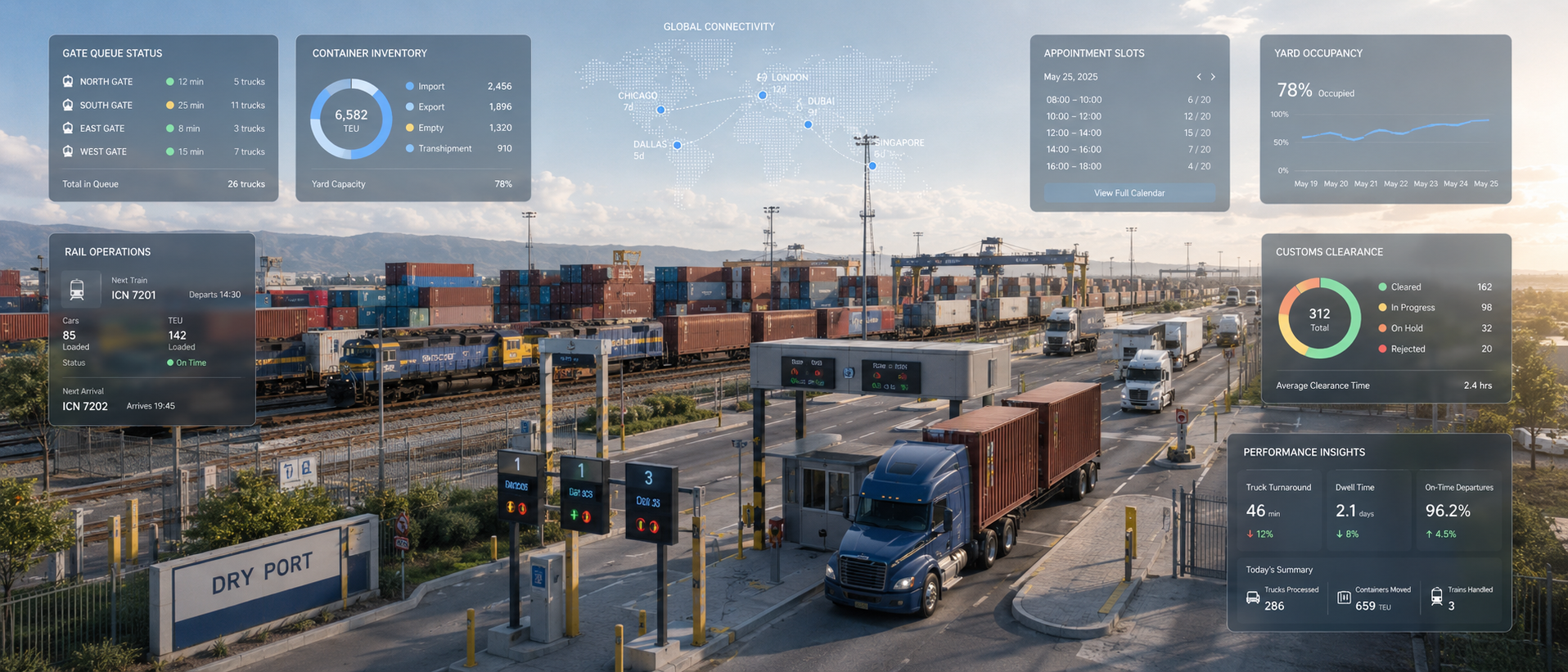
The IST Dry Port Management System manages inland container depot and dry port operations including customs coordination, container storage, movement tracking, cargo release workflows, and billing for inland terminal facilities.
Operational cycle
Inbound Receipt
Receive containers from seaports via rail or truck with documentation verification and physical inspection.
Customs Coordination
Manage customs declarations, examinations, holds, and release processes in coordination with customs authorities.
Storage & Yard Management
Allocate yard positions, track dwell time, and manage container stacking and retrieval.
Movement Tracking
Monitor container movements within the facility and between the dry port and connected seaports.
Release & Dispatch
Process cargo releases upon customs clearance and payment, coordinate outbound truck dispatch.
Billing & Settlement
Calculate handling, storage, and service charges with automated invoicing and payment tracking.
Inland Terminal Operations — Customs, Storage, and Cargo Release
The IST Dry Port Management System manages inland container depot and dry port operations including customs coordination, container storage, movement tracking, cargo release workflows, and billing for inland terminal facilities.
Quick answer
The IST Dry Port Management System helps inland terminals coordinate customs, storage, movement control, cargo release, and billing as one inland extension of seaport operations.
What usually pushes buyers to change
Container receipt, customs handling, yard control, and release often run as separate administrative workflows instead of one operational chain.
Dwell time grows when inland visibility breaks between the seaport, the dry port, customs, and final dispatch teams.
Handling and storage charges are difficult to govern consistently when customs events and physical movements are disconnected.
When this is the right time to buy
The dry port is handling more import flow and needs tighter customs-and-release discipline.
Inland dwell time, container visibility, or release speed is becoming a commercial issue.
Management wants a system that can connect inland operations more cleanly to seaport and customer workflows.
Who this is best for
Dry ports and inland container depots coordinating customs, storage, and release activity at scale.
Operators that need to behave like an inland extension of a seaport, not just a storage yard.
Facilities seeking better inland visibility, customs control, and revenue capture from handling and storage.
Operational complexity fit
Best fit where rail and truck flows, customs activity, and storage monetization all matter operationally.
Strong fit once manual tracking can no longer keep seaport, customs, and inland teams aligned.
Especially valuable for operators aiming to reduce dwell time without losing control over customs or billing.
Core capabilities
Customs Workflow
Integrated customs declaration processing, examination scheduling, and hold/release management.
Rail/Road Connectivity
Manage inbound and outbound movements via rail and road with schedule coordination.
Bonded Area Management
Track cargo in bonded zones with regulatory compliance and audit trail.
Multi-Modal Coordination
Coordinate with seaports, trucking companies, and rail operators for seamless cargo flow.
Typical integrations
Integration maturity to plan for
Identify customs checkpoints, release conditions, and seaport handoff events that must be reflected in the system.
Clean up container, customer, tariff, and location master data before go-live.
Confirm whether rail providers, trucking partners, or ERP systems need integration in the first phase.
Implementation approach
Define inbound receipt, customs states, yard control, release conditions, and charge logic before rollout.
Connect inland movement milestones and customs events into one operational record before expanding dashboards or portal access.
Phase customer visibility, financial controls, and cross-site reporting after the first live facility is stable.
What happens after go-live
Operators usually expand into BI, customer portal, and stronger seaport/system integration once inland control is stable.
Customs and operational history becomes easier to audit because events are attached to one container record.
Management can make better decisions about capacity, dwell patterns, and customer commitments.
Executive outcomes
Reduce inland dwell time by aligning customs, movement, and cargo-release decisions in one workflow.
Improve visibility from seaport arrival through inland release and outbound dispatch.
Capture handling, storage, and service revenue more consistently as inland complexity grows.
Departmental outcomes
Operations
Better control of receipt, yard placement, customs status, and release movement.
Customs coordination
Cleaner visibility into holds, examinations, and release readiness.
Finance
Stronger billing discipline around storage, handling, and related inland services.
Why buyers hesitate
Customs processes are partly outside our control
True, but your internal handling of customs states, release conditions, and movement visibility is still fully improvable.
We already track containers manually
Manual tracking may show location, but it rarely aligns operations, customs status, billing, and release decisions in real time.
The inland site is smaller than the seaport
Smaller sites still benefit when customs, storage, and release delay revenue and customer service.
Commercial model considerations
The biggest commercial gains usually come from dwell-time reduction and cleaner release flow, not just digitizing records.
Dry-port buyers often start with the customs-and-release bottleneck, then expand into customer-facing services and analytics.
The system becomes more valuable as inland facilities handle more customers and more integrated seaport flows.
Risks of not digitizing
Inland congestion becomes harder to manage once customs, storage, and release events keep living in separate records.
Revenue leakage grows as more handling and storage services are performed without a disciplined operational trigger.
Customer trust erodes when inland milestones cannot be explained clearly or quickly.
System add-ons that matter for this solution
System add-on
Customer Portal
Customer Portal gives cargo owners and agents visibility into inland status, documents, and release readiness.
Explore Customer PortalSystem add-on
Accounting & ERP
Accounting matters because inland handling and storage revenue can leak quickly in manual release environments.
Explore Accounting & ERPSystem add-on
EDI and Connectivity
EDI & Connectivity is important when the dry port must coordinate with seaport, customs, and partner systems.
Explore EDI and ConnectivityFrequently asked questions
Related resources
Related buying and implementation resources will appear here as this solution library expands.
Related solutions
Terminals
Terminal Operating System
A unified terminal management system that supports multiple cargo types — containers, breakbulk, general cargo, and RoRo vehicles — within a single operational environment.
Terminals
Container Yard Management System
Built for container yards, depots, and off-dock facilities that store, repair, and manage container equipment for shipping lines and leasing companies.
Terminals
Vehicle Storage Terminal System
Designed for vehicle storage terminals, automotive logistics parks, and vehicle processing centers that handle vehicle imports, storage, and distribution.