Terminales
Gestión de terminales de vehículos: recepción, almacenamiento y despacho
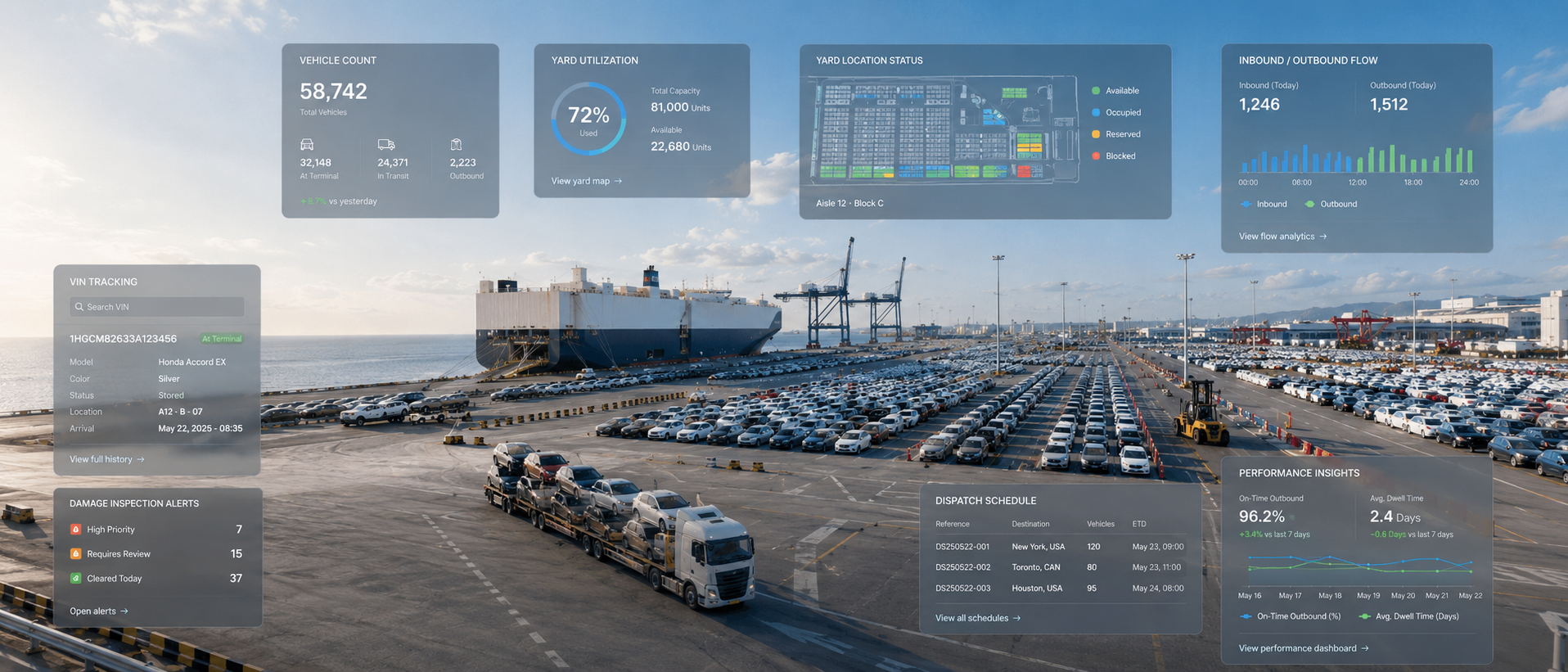
The IST Vehicle Storage Terminal System manages automotive and vehicle storage terminal operations including vehicle receiving, positioning, storage management, movement tracking, pre-delivery inspection, dispatch, and comprehensive reporting.
Operational cycle
Receiving
Receive vehicles from vessels, rail, or truck with condition inspection and documentation.
Positioning
Assign parking positions based on vehicle type, brand, destination, and release schedule.
Storage
Manage vehicle storage with dwell time tracking, periodic inspections, and security monitoring.
Movement
Track all vehicle movements within the facility including relocations and processing moves.
Dispatch
Process vehicle releases with delivery documentation, condition verification, and truck coordination.
Reporting
Vehicle inventory, dwell time analysis, throughput statistics, and customer reporting.
Vehicle Terminal Management — Receiving, Storage, and Dispatch
The IST Vehicle Storage Terminal System manages automotive and vehicle storage terminal operations including vehicle receiving, positioning, storage management, movement tracking, pre-delivery inspection, dispatch, and comprehensive reporting.
Quick answer
The IST Vehicle Storage Terminal System helps vehicle terminals control receiving, yard positioning, storage, PDI, damage tracking, dispatch, and reporting across automotive flows.
What usually pushes buyers to change
Vehicle position changes, condition checks, PDI tasks, and dispatch readiness are often tracked in separate operational logs.
Damage accountability becomes unclear when receiving and release inspections are not tied to one vehicle record.
Storage, handling, and accessory or PDI billing are easy to miss when throughput is high and yards are large.
When this is the right time to buy
The terminal is handling higher automotive volume and needs better inventory confidence and dispatch speed.
OEMs, shipping lines, or dealers want stronger visibility into vehicle status and damage traceability.
Management needs better control over dwell time, PDI backlog, and dispatch performance.
Who this is best for
Vehicle storage terminals, RoRo auto facilities, and automotive processing centers.
Operators handling imported vehicles that require storage, inspection, PDI, and dispatch coordination.
Terminals seeking more disciplined vehicle-level traceability and commercial control.
Operational complexity fit
Best fit where vehicle volume, yard size, or service complexity makes manual location control unreliable.
Strong fit when PDI, damage documentation, and dispatch readiness all affect customer satisfaction.
Especially useful for terminals balancing OEM expectations with high yard movement activity.
Core capabilities
Vehicle Identification
VIN-based tracking with make, model, color, and destination attributes.
Yard Mapping
Visual parking layout with position assignment and vehicle location search.
PDI Management
Pre-delivery inspection workflows, accessory fitting, and quality control tracking.
Damage Tracking
Condition surveys at receiving and dispatch with photo documentation.
Typical integrations
Integration maturity to plan for
Identify VIN master-data dependencies, OEM references, and customer dispatch requirements.
Clean up inspection templates, damage categories, and location conventions before rollout.
Plan whether dealer, OEM, or financial systems require early integration.
Implementation approach
Set up yard zones, VIN logic, vehicle states, inspection workflows, and dispatch rules first.
Move receiving, PDI, movement, and release checks into one live vehicle record before expanding reporting depth.
Add customer visibility and financial controls after the terminal trusts the operational status model.
What happens after go-live
Vehicle history becomes easier to prove for OEMs, dealers, insurers, and terminal leadership.
Operational teams can manage dwell and processing queues with better confidence and fewer manual checks.
The terminal can expand reporting, portal access, and commercial service layers on top of a stronger operational record.
Executive outcomes
Improve vehicle inventory accuracy and reduce search time across the facility.
Strengthen damage accountability from receiving through final dispatch.
Reduce dwell time with better coordination between storage, PDI, and dispatch teams.
Departmental outcomes
Yard operations
Clearer position control and faster retrieval of vehicles for processing or release.
PDI and quality
Better visibility into work queues, completion status, and inspection outcomes.
Commercial and finance
More reliable capture of storage, handling, PDI, and related service charges.
Why buyers hesitate
The team already knows where vehicles are
That may work at lower scale, but it does not provide the traceability or reporting larger automotive customers expect.
PDI is a separate function
It still affects dispatch readiness and customer timing, so it needs to be visible in the same vehicle record.
Damage capture is mostly manual today
That is exactly where disputes and accountability gaps tend to appear when volume increases.
Commercial model considerations
The ROI usually comes from faster throughput, fewer search delays, stronger damage control, and better monetization of services.
Automotive customers value proof and status discipline, so operational visibility can directly support retention and growth.
Rollout often starts with receiving and yard control, then extends into PDI, quality, and billing depth.
Risks of not digitizing
Search time and dispatch delay increase as yard volume grows and positions change more frequently.
Damage disputes become harder to resolve when inspections are not unified around one digital vehicle history.
PDI and storage revenue are easier to miss when dispatch readiness is managed manually.
System add-ons that matter for this solution
System add-on
Customer Portal
Customer Portal gives OEMs, dealers, or principals visibility into inventory, status, and release readiness.
Explore Customer PortalSystem add-on
BI and Analytics
BI & Analytics helps leadership monitor dwell, processing backlog, and service performance by customer or brand.
Explore BI and AnalyticsSystem add-on
Accounting & ERP
Accounting protects storage, handling, PDI, and ancillary revenue in automotive terminal operations.
Explore Accounting & ERPFrequently asked questions
Related resources
Related buying and implementation resources will appear here as this solution library expands.
Related solutions
Terminals
Terminal Operating System
A unified terminal management system that supports multiple cargo types — containers, breakbulk, general cargo, and RoRo vehicles — within a single operational environment.
Terminals
Dry Port Management System
Purpose-built for dry ports and inland container depots that serve as extensions of seaports, handling customs clearance, storage, and cargo distribution.
Terminals
Container Yard Management System
Built for container yards, depots, and off-dock facilities that store, repair, and manage container equipment for shipping lines and leasing companies.